
Healthwashing: Awareness can reduce regulatory risk and protect brands
- Posted:
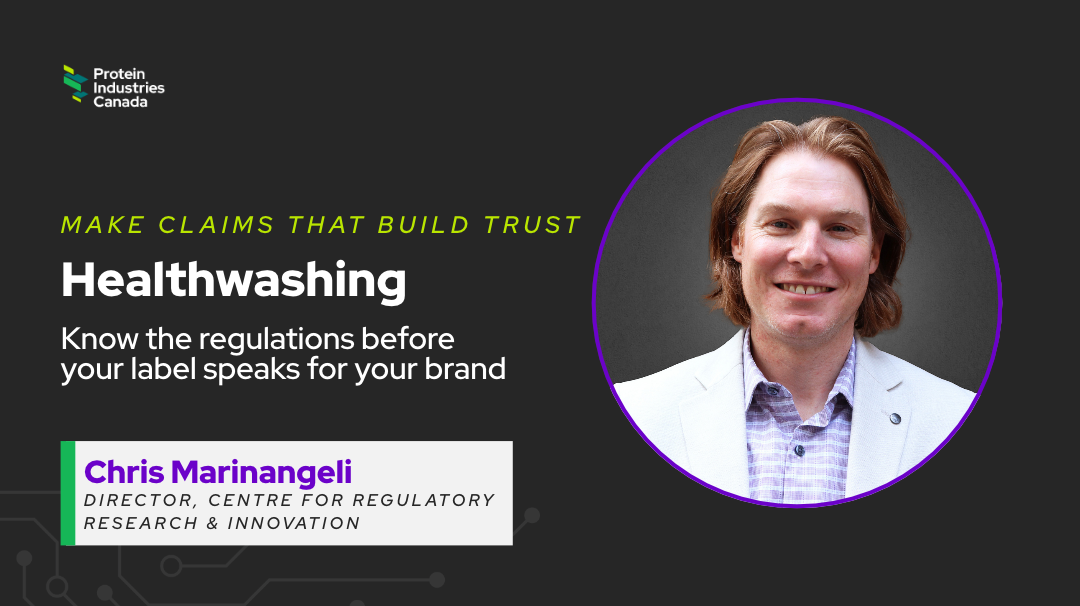
Written by: Christopher Marinangeli PhD, RD (Director, Centre for Regulatory Research & Innovation)
From fruits and vegetables to packaged goods, the food industry is passionate about the foods they sell to consumers. And rightfully so. Foods and diets have a huge impact on our lives. Food elicits a strong emotional response through our senses and associations with family and community. It can be instrumental in personal health and wellbeing and can be part of a larger narrative with personal beliefs around sustainable food systems, food security and food sovereignty. Brands and their food offerings can differentiate based on a variety and combination of factors. Emphasizing “great taste” is probably the most common, whereas price will always be an important consideration across most demographics.
However, product differentiation also manifests as functional benefits brought to the consumer or society. In its most basic form, a claim on a label that highlights that the food is a “source” of a nutrient (i.e. protein) is common. In today’s food environment, protein for example, remains as strong product differentiator for many consumers.(1) However, there are also opportunities for more specified claims to be used. These can be claims that communicate physiological function, disease prevention and even environmental sustainability. Heightened use of GLP-1 medications for weight loss has spawned new food innovation that is protein dense in smaller serving sizes to target the specific needs of GLP-1 users.(2) But what you can and can’t say will require a regulatory assessment in the target country or jurisdiction.
As consumers, we often take larger concepts and distill them down to manageable pieces of knowledge that we apply to everyday food decisions. For example, dietary guidelines or media may communicate a general narrative that plant-based diets are associated with reduced risk of cardiovascular disease. This might cause a consumer to choose a plant food of their own fruition to help adopt a more plant-forward dietary pattern based on their own beliefs and not based on a claim on a label. However, this can be different from a specific claim found on a food product.
Food products that carry specific claims around health or environmental sustainability, for example, are often subject to labelling regulations that specify standards of evidence required to make a claim, the wording, and/or may require regulatory review.
Over the last few weeks, I was reminded of the importance of understanding country-specific regulatory compliance with a series of lawsuits filed against industry in the United States for claims made on food. The first was around “immunity boosting” and “doctor crafted” claims made on a juice-type product with added food ingredients to support the claim.(3) The Plaintiff alleges that the claim is false and misleading because they are not substantiated scientifically and that foods do not “boost” the immune system. In 2009, the US Federal Trade Commission investigated Kellogg Company for making similar immunity claims on a breakfast cereal, which resulted in a 20-year order, that included record keeping restrictions for any claims made on their foods.(4; 5) Immunity type claims are permitted for foods that are a source of nutrients involved in immunity function. In Canada, for example, it can be claimed that vitamin A “contributes to the normal function of the immune system,” which is scientifically different than “immunity boosting.”
The second lawsuit is also complex. It alleges that a “0 g total sugar” claim is misleading because allulose was used as a sweetening ingredient. Allulose is a monosaccharide. Monosaccharides are small carbohydrates that are often characterized as a “sugar.” Sugar as a food ingredient (i.e table sugar) is a disaccharide, consisting of 2 monosaccharides (glucose and fructose) that are bound together. Often, mono- and disaccharides of different types are characterized as “sugars” in nutrient tables and ingredient lists on food products. Allulose is found naturally in small amounts of common foods (fruit, molasses, wheat, and there).(6) It is 70% sweeter than sugar, and 0.2 to 0.4 kcal/g (vs. 4.0 kcal/g in table sugar), and is not metabolized.(6) Allulose is considered a low-calorie sweetener and, because of its enhanced sweetness compared to sugar, only a small amount is required to achieve the same level of sweetness as sugar.
But given that allulose is a monosaccharide and carbohydrate by definition, the question is whether the claim “0 g of sugar” on an allulose-containing food is misleading. US Food and Drug Administration’s guidance on allulose states that allulose is a carbohydrate and should be calculated as contributing 4 kcal/g energy to the product, despite 0.2 kcal/g to 0.4 g attestations from citizen petitions.(6) Because allulose is not metabolized, does not increase blood sugar or insulin, or cause dental caries, the FDA is exercising enforcement discretion as to whether allulose is included in the calculated amount of “total sugars” and “added sugars” declared on the nutrient facts table food products.(6) Obviously, this can become complicated, and unclear if the FDA’s discretion extends to a “0 g of sugar” claim. Allulose has not been approved in Canada or Europe as a low-calorie sweetener.
The outcome of either case is to be determined and require an analysis that either claim is or is not misleading to consumers in context of product positioning and current food regulations and policies. Both of these examples could be framed as alleged cases of “healthwashing.” A “washing” claim makes a food appear better than what the evidence, or lack thereof, demonstrates. But washing claims have also been found in other areas. Greenwashing refers to unsubstantiated claims around environmental sustainability. A 2021 analysis by the International Consumer Protection Enforcement Network showed 40 per cent of 500 websites were using sustainability claims that could be considered misleading.(7) In fact, countries, including Canada, have recently updated regulatory oversight to prevent greenwashing in the marketplace.(8)
Food laws and regulations are in place to prevent consumers from being misled in the marketplace. But this does not preclude the opportunity for product differentiation using evidence and scientifically sound substantiation. Some claims might be easier to make than others and require different levels of regulatory oversight. For example, nutrient content claims (“source of” a nutrient) are prescriptive, others may require an internal scientific substantiation, while still others require a preassessment from regulatory agencies. Also, it would be wrong to assume that cases of non-compliance imply negative intent from food industry stakeholders. It is fair that different interpretations of the regulations and lack of awareness may precipitate enforcement action by the regulator. The recommendation herein is to understand the regulatory environment in the context of your food and brand, and what you want to say with a risk assessment to determine if messaging is open for interpretation.
For myself, as a nutrition and regulatory scientist, understanding the benefits of food products is an exciting aspect of our food environment. They can help drive personal and meaningful benefits to consumers and society, and in many cases, align with an overall brand strategy. But it is equally as important to understand that regulations are in place to protect consumers from being misled, and, in doing so, may also protect your brand’s equity in delivering on their expectations.
Written by

References
1. Allison C. (2026) Good Source of Protein Insights Rising demand makes protein a key differentiator for brands and retailers. In Grocery Business Magazine, pp. 84-85. Bowmanville, ON: Grocery Business Media. Vol 16, no. 1.
2. Walker L. (2026) Wellness in 2026: Tapping into This Year’s Healthy Shopper. In Grocery Business Magazine, pp. 96. Bowmanville, ON: Grocery Business Media. Vol 16, no. 4.
3. Keller & Heckman (2026) Wellness Supplement Sued Over ‘Immunity’ Claims. https://www.dailyintakeblog.com/2026/09/wellness-supplement-sued-over-immunity-claims/ (accessed October 5, 2026 2026)
4. United States of America Federal Trade Commission (2010) FTC Investigation of Ad Claims that Rice Krispies Benefits Children's Immunity Leads to Stronger Order Against Kellogg. https://www.ftc.gov/news-events/news/press-releases/2010/06/ftc-investigation-ad-claims-rice-krispies-benefits-childrens-immunity-leads-stronger-order-against (accessed October 5, 2026 2010)
5. United States of America Federal Trade Commission (2010) Order to Show Cause and Order Modifying Order ORDER In In the Matter of DOCKET NO C-4262 KELLOGG COMPANY a corporation vol. DOCKET NO. C-4262 [FT Commission, editor].
6. US Food and Drug Administration (2020) The Declaration of Allulose and Calories from Allulose on Nutrition and Supplement Facts Labels: Guidance for Industry. https://www.fda.gov/media/123342/download (accessed October 5, 2026 2026)
7. UK Competition and Markets Authority (2021) Global sweep finds 40% of firms’ green claims could be misleading. https://www.gov.uk/government/news/global-sweep-finds-40-of-firms-green-claims-could-be-misleading (accessed October 5, 2026 2026)
8. Government of Canada (2025) Environmental claims and the Competition Act. https://competition-bureau.canada.ca/en/how-we-foster-competition/education-and-outreach/publications/environmental-claims-and-competition-act (accessed October 6, 2026 2026)